
Now that we have safely passed the three month mark, it feels like we are adjusted enough to Neta to write up a daily routine.
The day always begins at 05:30 when, without fail, I wake up needing the toilet. A ‘pee in the dark’ is a Neta speciality of trying to navigate around a variety of obstacles (shoes, chickens, the hose, plant pots, steps, tigers, etc) to get to the toilet which is round the back of the house. Returning to my bed now fuelled with adrenaline I will normally read or lie on my phone until sunrise which is currently about 06:30.
Then, depending on the day, I will go for a run down and alongside the valley. I am managing this about 2-3 times a week but it is definitely getting more difficult to leave my sleeping bag as the weather gets colder. However, when I do manage it the views of sunrise and the valley are always worth it or at least this is what I repeat to myself as I crawl the 200m uphill on the way home (often requires several ‘sit and thinks’ along the way). By 07:30 when I arrive home our host Parvati will have at least one friend around for tea. She always makes Selin and I a cup and we’ll sit on the porch and chat to whoever has come over.
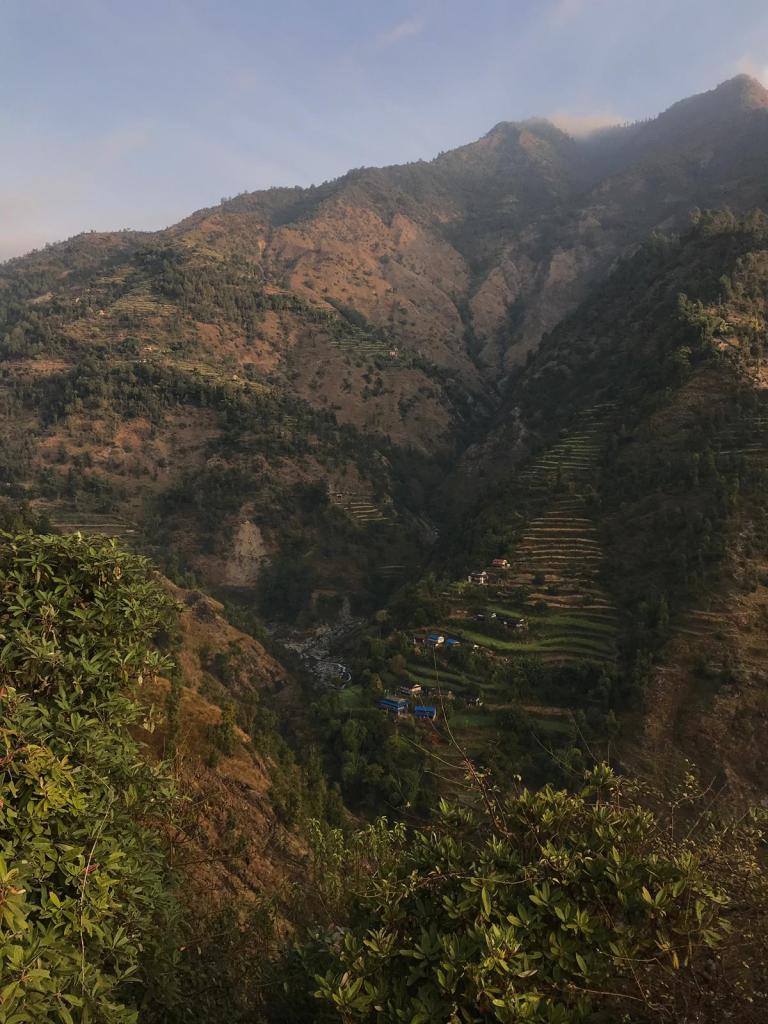
Selin or I then walk up behind the house to connect our hose to the water supply and replace the buckets of water from the previous day, clean the toilet and then will sometimes shower. Our shower is a small room beside the toilet with a small grate we can stick the hose through into a bucket inside. It’s actually very private for Nepali standards – it has a door and everything. Showering is also becoming tougher; Selin opts for the start at the bottom and work your way up approach, finishing with your hair, arguing you stay warmer as your hair only gets wet at the end whereas I can vouch that if you start by throwing ten buckets of water over your head “it’s not actually that bad”. Regardless, after showering we both lie out in the sun like cats to restart our circulation.
Then it is breakfast time. Depending on the day breakfast consists of a fresh dal bhat, leftover dal bhat or if we’re lazy and unorganised, a packet of biscuits each. If we’re lucky Parvati will appear with her own leftovers for the two of us. She often has random dals and curries as she has to be prepared for when unexpected guests or local kids arrive hungry. It’s always a good day when this happens as she’s an amazing cook. After breakfast it’s usually time for school. A few mornings a week we wash our clothes by leaving them to soak for an hour and then repeatedly rinsing and ringing them out.
School begins at ten although kids will often come to collect us beforehand with vegetables for us (and in search of sweets and stickers). We regularly arrive at school to find ourselves the only teachers on time however this is unfair as all the other teachers walk (or motorcycle) 2 hours uphill from the town at the base of the valley compared to our thirty second walk up from our house. The first bell (a small gong in the office) rings at ten, signalling either the start of their line formation or time to clean the classrooms. These happen on completely random days and whilst we have no idea what’s going on, everyone else always knows if it’s a line or a cleaning day. If it’s a line day the children line up with class eight girls on the far left and boys on the far right. The rest of the school fills in, descending in age until class one girls and boys stand in two lines besides one another in the centre. The teachers then give the kids a series of commands military style such as “stand at ease”(legs apart), “attention” (legs together), “arms up” and “clap” (a three beat clapping rhythm which is the only rhythm the kids can clap to – class two got very confused when I tried a new one with them). All commands are given in English and it’s quite bizarre and amusing to Selin and I. Following this school announcements are made, the national anthem sung and the kids are dismissed to class.
If it’s a cleaning day the kids will sweep their classroom floor with bound grass brushes and carry the piles of dirt out by hand. To prevent rooms getting dusty they then sprinkle water over the floor with instant noodle packets. All these pre-school activities means lessons never begin at 10:15 and so instead of 45 minutes with Class Four, I get more like 30 minutes.
Class Four is definitely full of big characters. There’s about 12 kids in the class (hard to know as they’re never all present) and with 2/3 being girls there’s always drama over who’s sitting with whom. As they’re our only shared class Selin and I like working out who has fallen out everyday (which often has changed between when I teach them at 10:30 and when Selin teaches them at 11:45). They’re an incredibly loud class but a lot of fun – highly motivated by stickers.
I have no timetabled classes between 11 and 12:30 and so will sit in the office or outside and lesson plan or learn Nepali or chat to the teachers. At 12:30 I begin Class Five. I only get a maximum of half an hour with them because for some reason fourth period is 15 minutes shorter than the rest, but they’re a really great and eager to learn class. There is slightly more pressure on Class Five as their end of year exams actually count and apparently they can’t cheat unlike the rest of the year groups. A struggle with Class Five is that half the boys names begin with S – Sanju, Santosh, Shuman, Shiba and Sandip – it gets confusing. As well as my students, my morning classes are regularly attended by dogs (who the kids will throw stones at) and the others teachers’ babies/toddlers. Parenting and teaching are evidently complementary as shown through teachers breast feeding toddlers and teaching eleven year olds simultaneously however two year olds are quite distracting wandering around the classroom eating a packet of biscuits (even if they do share). Dogs however are better than most students.
Selin and I plan our lessons roughly around the extremely questionable Nepali textbooks. They are full of random chants about cleaning blood on Wednesdays and stories of men with multiple wives not to mention the spelling and grammatical errors. We can’t even decipher what some of the exercises are asking the pupils to do and so we definitely use these as a rough outline to teaching. Nepal has thrice yearly exams entirely based on the textbook but these are very relaxed. The teachers go way beyond ignoring cheating by spelling out the answers letter by letter to classes one, two and three. After class four exams get slightly more serious and the pass rate significantly drops. These exams involve memorises large passages or stories in the textbook to answer questions such as “how many big fish were in the lake?”. Because the younger years can cheat these exams, Selin and I can focus on actually teaching them English and we only use the textbooks as loose topic guidelines.
After class 5 it is lunchtime or as our head insists ‘Tiffin Time’. Although this is timetabled as 45 minutes, it is always at least an hour messing up the rest of the schedule. We normally get nasta (a small lunch/snack – breakfast and dinner are large meals) consisting of fried spicy chickpeas, instant noodles, non-instant noodles, roti and tea or flavoured rice. This is not very filling but the kids take care to feed us and share popcorn and chow chow with us from their pockets (a girl once gave us each a handful of sugar straight from her pocket).
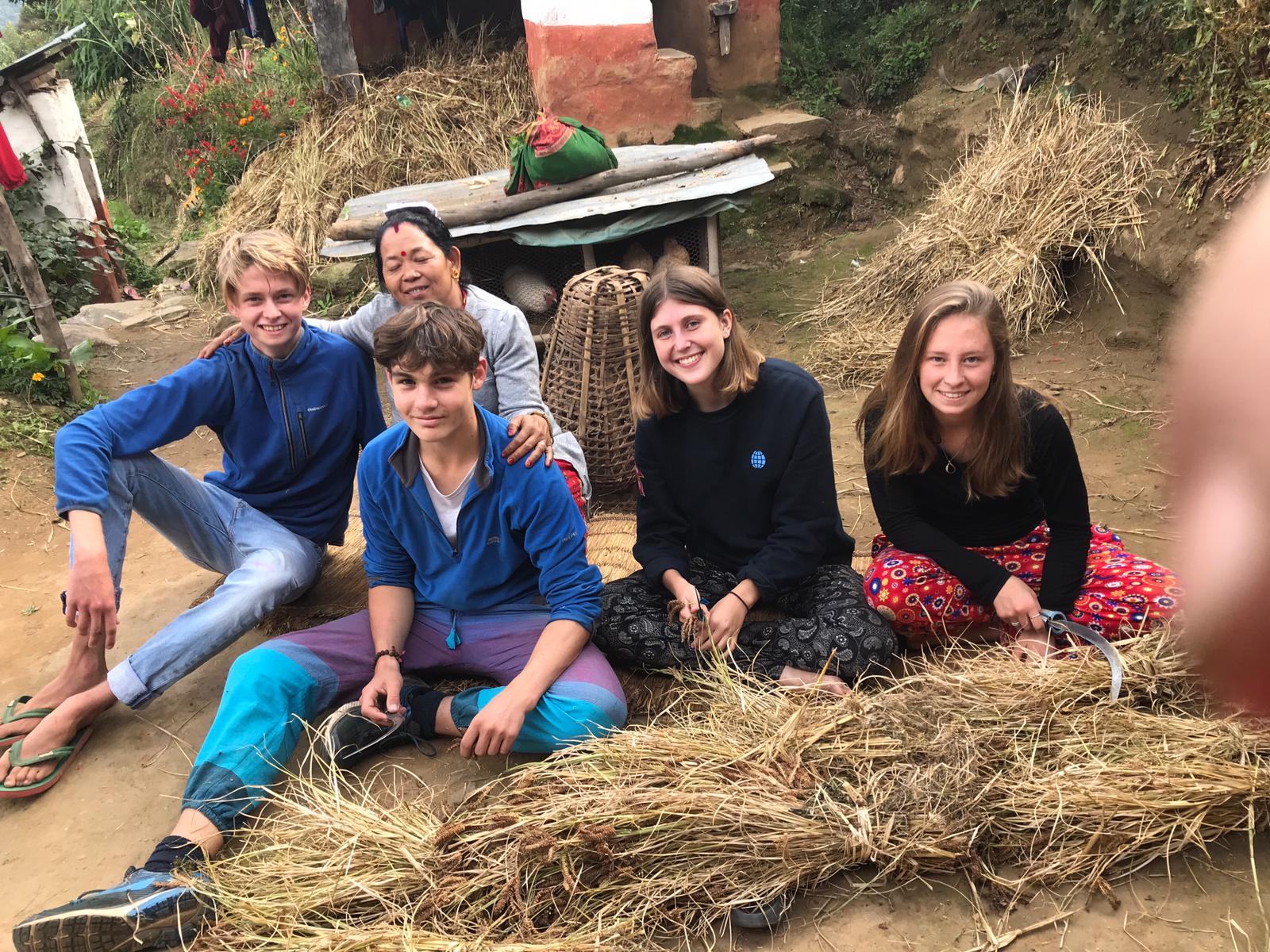
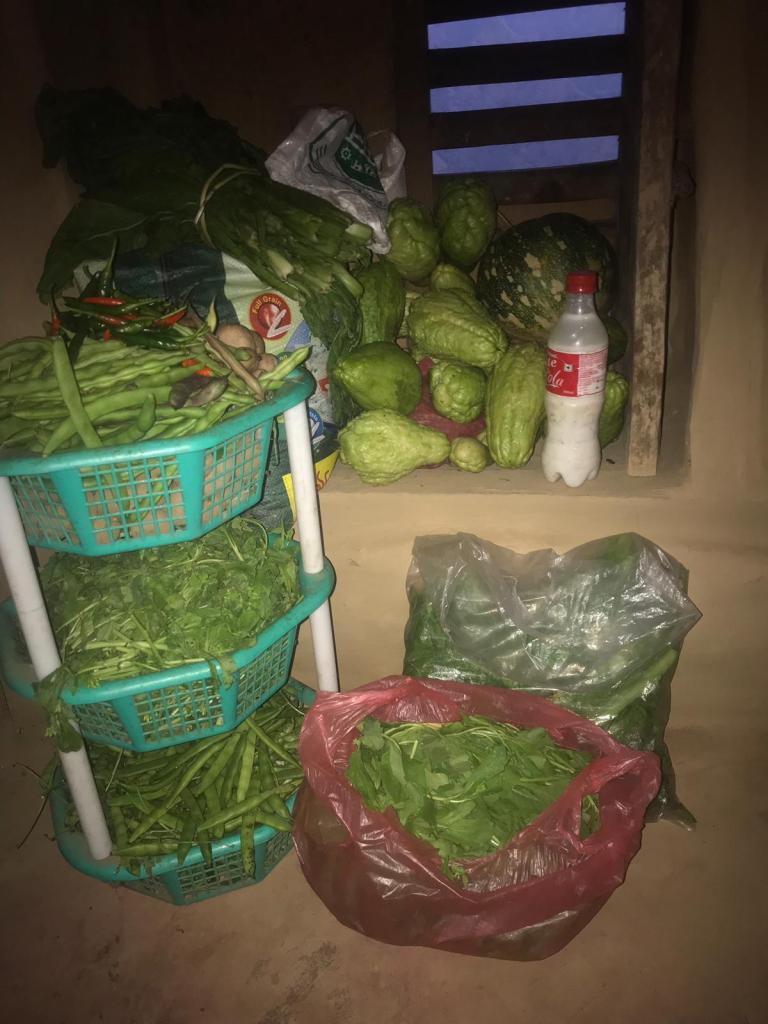
In the afternoon Selin and I each only have one 2 hour class – for me, class two (6-11 year olds) and for Selin, class one (3-11 year olds). These classes are incredibly draining, made much more challenging by the large age differences. Finding activities to suit the class is practically impossible – Selin is basically a childminder with some class ones who have wet themselves and worse mid lesson. Class two can be really great some days and then terrible the next depending on who’s acting up or who’s present. The classroom discipline is currently a happy and sad list where those on the happy list get a sticker at the end of class whilst those with three strikes on the sad list go to the office. This is working so far and the kids beg not to be moved to the naughty list. Stickers are the strongest bargaining tool for all classes and we reward kids with three if they bring us spare vegetables from home to cook as we don’t have a garden to grow food unlike everyone else.
School ends at four and we go home and collapse for a bit after class one and two. After school we have some free time when we’ll often go on a ‘nasta crawl’ or walk an hour to the shop for snacks. A nasta crawl is walking around Neta hoping people invite us in and feed us and has made us lots of friends. A sign of a successful nasta crawl is not having to cook dinner or if someone invites us to stay for dinner (or a sleepover). However, we keep nasta crawls to under two a week to avoid the community growing suspicious. In the evenings (if we don’t nasta crawl or it’s unsuccessful) we will cook another dal bhat. We have electricity from about 6pm-6am and so far it’s very reliable with only a few power cuts but we expect this will get worse in summer and the monsoon season.
A couple nights a week we will watch a movie (left by last years volunteers – thank you so much!) or Netflix which we download whenever we walk down to Aglung Pedi (town at the bottom of the valley) where there is a WiFi shop with whom we’re very friendly. Our favourite evenings are spent with a packet of biscuits and our precious spreads (pb, fake Nutella, jam and honey bought from Kathmandu and Pokhara) or, on special days, our strictly rationed English snacks (also from Kathmandu and Pokhara but hopefully we will receive a parcel of snacks soon). We must be quite funny to watch as we nibble a few squares of chocolate over about half an hour (it isn’t even that good as it’s made with milk powder).
Every night we are exhausted by nine and go to bed however right now we’re being woken up by the rats that have made a nest in our walls. So far they haven’t eaten much – just an iPhone charger and Selin’s mozzy net. I can now say I have caught a live rat – that’s Nepal for you.

 A Year in Nepal
Wow this really reminds me of my year in Indonesia with Project Trust. Although mine was a lot easier because I was teaching in a university. Well done Kate – sounds like you’re doing a fantastic job.
LikeLike